 Neighborhood Plants Video Series brings the rangelands to your neighborhood! Each month, we’ll bring you new videos to help you explore the diversity of Texas plants from your own “backyard”. Check back often to see what’s in bloom and learn how to identify these Texas plants! Follow my Youtube Channel Stacy Hines to find more plants.
JANUARY
 Blue Mistflower – a native perennial subshrub that is found growing across neighborhoods and rangelands. Blue mistflower is a valuable food resource for many pollinators. The seeds are consumed by granivorous birds, and the plant is browsed on by wildlife.
 Spiny Sow Thistle – a non-native annual forb that is found growing across neighborhoods and rangelands. Spiny sow thistle looks very similar to common sow thistle (S. oleraceus), but spiny sow thistle has rounded basal leaf lobes while common sow thistle basal leaf lobes are more pointy or triangular in shape. Spiny sow thistle is a valuable food resource for many pollinators. The seeds are consumed by granivorous birds- such as gold finches. The plant is browsed on by livestock and wildlife, especially when it is young and tender.
 Scarlet Sage – a native forb that is found across neighborhoods and rangelands. Scarlet sage grows 30-40 inches in height and has one-inch-long flowers that attract pollinators, such as hummingbirds and butterflies. The flowers can be in bloom any time of the year and this native plant grows well in partial shade or full sun.
 Texas nightshade – a native vine growing across neighborhoods and rangelands. Texas nightshade can sometimes grow as a semi-climbing shrub with woody stems. It provides forage for pollinators and birds. However, it is toxic to many other species – including cattle and humans.
FEBRUARY
 Anaqua or Sandpaper-tree – a native shrub or tree that is found growing across neighborhoods and rangelands. Anaqua (syn. Anacua) benefits many species, including humans. Humans use the wood for fenceposts and tool handles and often use this native tree as a landscape tree. The many small, white flowers attract an abundance of pollinators. Many birds and mammals, like coyotes and raccoons, consume the fruits. White-tail deer will sometimes browse on the leaves.
 Catchweed Bedstraw – a native forb that is found growing across neighborhoods and rangelands. Catchweed bedstraw is also commonly called goose grass because geese eat the seeds, in addition to other birds such as wild turkeys and prairie-chickens. Large mammals and livestock will eat bedstraw, but it is a small component of their diets. Some small pollinators will visit the tiny flowers.
 Dwarf Palmetto – A native shrub growing across neighborhoods and rangelands. Dwarf palmetto provides food and cover for pollinators, birds, and small mammals. The fruits are also consumed by cattle and white-tailed deer.
 Spanish Moss – A native forb/vine growing across neighborhoods and rangelands. It is an epiphyte- meaning it is an “air” plant that obtains water and nutrients from the air. It grows on trees but is not parasitic- Spanish moss only uses its host tree for support. Spanish moss provides shelter and nesting cover to a variety of species, including insects, spiders, bats, and birds. In the winter, livestock may graze on dried Spanish moss that has fallen to the ground.
MARCH
 Prickly Poppy – a native forb that is found growing across neighborhoods and rangelands. There are many species of prickly poppy that are native to Texas. Flower petals colors can be deceptive in distinguishing the species. For example, the flower petals of red poppy (Argemone sanguinea) may be red, pink, purple, or white. Prickly poppies are a valuable resource for pollinators.
 Knotted Hedgeparsley – a non-native forb growing across neighborhoods and rangelands. The barbed covered fruits are a key distinguishing feature of this plant. Pollinators visit the flowers, and the fruits are eaten by some birds and small mammals.
 Bur Clover– a non-native legume that is found growing across neighborhoods and rangelands. Bur clover looks like an ordinary clover, but upon closer inspection, you’ll see the bur-like prickly fruits. After touching bur clover, it has been advised to wash your hands before touching your eyes because eye irritation has been reported after people touch the plant and then their eyes. Bur clover is beneficial. It is used for soil restoration because it provides organic matter in well drained soils and adds nitrogen to the soil yielding approximately 50-125 pounds of nitrogen per acre. It has a high protein content, so it is mixed with oats and wheat to provide livestock forage during winter and spring. As with all legumes, keep an eye on livestock for any signs of bloat. The dry burs are readily eaten by deer and quail. The flowers provide nectar to a variety of pollinators.

Ball Moss – A native forb-herb growing across neighborhoods and rangelands. It is an epiphyte- meaning it is an “air” plant that obtains water and nutrients from the air. It grows on trees but is not parasitic- ball moss only uses its host tree for support. Ball moss provides shelter to a variety of species, including insects, spiders, small reptiles, and amphibians. It can be used as nesting material for birds, and the array of insects living in ball moss provides a bird buffet. It fixes nitrogen from the air into a useable form for other plants. When it falls to the ground and decomposes, it adds this essential nutrient to the soil- benefiting other plants.
APRIL
 Scorpions Tail – a native forb or subshrub growing across neighborhoods and rangelands. This plant has the ability to bloom anytime of the year. Thus, it provides a valuable food resource for pollinators. The seeds are consumed by some birds.
 Herb of Grace – a native forb growing across neighborhoods and rangelands. This plant is found in areas where water has been standing for a long time. Another common name is coastal water hyssop. It provides a valuable food resource for pollinators.
 Beach morning Glory – A native vine growing across sandy dunes. Beach morning glory roots at the nodes along the viney stem, making it an important plant to help stabilize dunes. As suggested by its name, the white flowers open in the morning and close in the afternoon. The large flowers provide a nectar source for pollinators, such as bees and hummingbirds. The seeds provide forage for small mammals.
 Searocket – A native forb growing across sandy dunes. There are several searocket species that can be found growing in Texas. Searockets are an important pioneer species that helps to stabilize dunes. The flowers provide a nectar source for pollinators. The underground parts of the plant provide a food resource for the larvae of many insects. It can provide hiding and shade cover for many small animals.
MAY
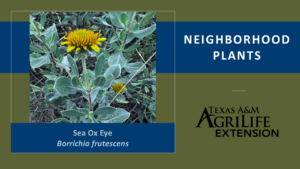 Sea Ox Eye – Also called Sea Daisy, a native perennial subshrub that is found growing across neighborhoods and rangelands. Sea ox eye grows in ‘salty’ soils. The daisy-like flowers have yellow ray and disk flowers, and the disk flowers have many sharp-pointed scales. Sea ox eye flowers provide nectar to many bees and butterflies and seeds to birds. They can grow up to 32-inches tall, so they also provide cover.
 Mustang grape – A native perennial vine that is found growing across neighborhoods and rangelands. Mustang grapes are easily recognized by the white, velvety surface on the underside of the leaf. The fruit of mustang grape provides forage for birds and small mammals, and is popular with people that make homemade wines.
 Orange Zexmenia – a native shrub growing across neighborhoods and rangelands. This plant keeps blooming most of the year. Thus, it provides a valuable food resource for pollinators. It is drought tolerant, making it a reliable garden ornamental.
 Lizard Tail – A native forb growing across rangelands and neighborhoods. Lizard tail is a hardy plant – adapted to grow in poor quality soils. It provides a nectar source for pollinators- especially bumblebees. It also serves as a larval host plant for many moth species. It supports a suite of insects, which in turn provides food resources for other wildlife species.
JUNE
 Turk’s Cap – also called wax mallow, a native perennial subshrub/shrub that is found growing across neighborhoods and rangelands. Turk’s cap, Malvaviscus drummondii or M. arboreus var. drummondii, is very similar to the cultivated variety of turk’s cap (M. Penduliflorus) that is often found in neighborhood gardens. The biggest difference between the native and the garden varieties can be seen at the base of the leaves where the leaf stem meets the leaf. The leaf base of the native turk’s cap is heart shaped, while the garden variety has a rounded leaf base. The native turk’s cap produces a fruit that is eaten by wildlife. The flowers provide nectar to hummingbirds and butterflies. Turk’s cap is also a host plant for larvae of the Mallow Scrub-hairstreak and Turk’s Cap White-skipper butterflies.
 Retama – also called paloverde, a native perennial shrub/tree that is found growing across neighborhoods and rangelands. One of the most distinguishing features of retama is the green branches. Be careful if you investigate the branches closely as they have many curved thorns along them. During drought, the leaves often fall off and the green branches will become a brighter shade of green because the branches take on the role of photosynthesis. It is a useful plant for many wildlife and livestock species. The flowers provide a source of nectar for pollinators, the seeds are consumed by small mammals and birds, the foliage and pods are eaten by wildlife and livestock during times when other foods are less available. It also provides nesting sites and cover for wildlife.
 Spiderling Species – a native forbs growing across neighborhoods and rangelands. There are several species of spiderlings in Texas. Spiderlings may be difficult to distinguish because they are polymorphic, which means they can have many different forms. This plant is valuable as a food resource for many species, including pollinators, wildlife, and livestock.
 Plains gaura -A native forb growing across rangelands and neighborhoods. It provides a nectar source for pollinators and serves as a larval host plant for several moth species. It supports a suite of insects, which in turn provides food resources for other wildlife species. In addition, it provides food for wildlife- fawns and adult deer in South Texas browse on this plant.
JULY
 Sensitive Brier – a native perennial forb that is found sprawling across neighborhoods and rangelands. One of the most distinguishing features is the numerous pink pom-pom-like flowers. Be careful if you investigate the flowers or sensitive leaves, as this plant has many thorns. Sensitive brier is a useful plant for many wildlife and livestock species. The flowers provide nectar for pollinators, and the foliage is eaten by wildlife and livestock.
 Silverleaf Nightshade – a native perennial forb that is found across neighborhoods and rangelands. One of the most distinguishing features are the long, narrow leaves with wavy edges. Be careful if you investigate the plant, as it may have many thorns. Silverleaf nightshade provides a nectar source for pollinators and some birds do eat the fruits. However, all parts of this plant do contain toxins, so it is rated as poor forage for livestock and wildlife.
 Procumbent Pigweed – A non-native forb growing across neighborhoods and rangelands. This plant can be weedy and a nuisance in agriculture fields. However, it has been reported that the leaves and seeds are edible. Although, we urge caution before consuming any foraged plant- ensure proper identification. Procumbent pigweed does have look-a-likes in Texas.
 Queen’s Wreath – A non-native vine growing across rangelands and neighborhoods. It provides a late summer to fall nectar source for pollinators. The seeds and fruits provide food resources for birds and small mammals. While it has some benefits to wildlife, this vine can be invasive. Its rapid growth may allow it to outcompete native plants.
AUGUST

Sea Oats – A native perennial grass that is found across beach neighborhoods and rangelands. One of the most distinguishing features are the large seed heads with flat spikelets. Seeds are inside the spikelets when they turn brown. Sea oats can grow up to 6-8-feet in height and their roots can extend 40-feet down. The massive root system helps to stabilize dunes on beaches. The large grass provides cover for small animals. The seeds provide food for birds and rodents and some butterflies lay their eggs in the leaves.

Beach Croton – a native perennial forb or subshrub that is found across beach neighborhoods and rangelands. Distinguishing features include the brown stems and veins and the dots on the underside of the leaves. Beach croton may be in bloom anytime of the year and it produces a 3-seeded fruit. Because it is a native plant that grows well in sandy soils, it helps to form and stabilize dunes in coastal areas. It also provides shelter for small animals.

Texas Lantana – a native shrub growing across neighborhoods and rangelands. There are many species of lantana. TX lantana key identifying characteristics include leaf margins with coarse teeth and lanceolate bracts. This hardy shrub provides forage for birds and pollinators. However, it is toxic to livestock.
 Globe amaranth species– native forbs growing across rangelands and neighborhoods. There are several species of globe amaranth in Texas. They all benefit pollinators, and most are resistant to deer and rabbits. One globe amaranth species that is found in southwest Texas also benefits small mammals and toads. Depending on the species, the flowers can range in color from white to pink to orange to red. They tend to maintain their color in dried flower arrangements.
SEPTEMBER
 Alamo Vine – a native perennial vine that is found across growing neighborhoods and rangelands. Distinguishing features include the deeply lobed palmate leaves, and the mature seed capsules that look like flowers. The flower, not shown in the video, looks like a morning glory flower. The flower provides nectar and pollen for pollinators. It is a larval host for the Painted Crescent butterfly. It also provides cover for small animals.
 Pyramid Flower – A native forb growing across neighborhoods and rangelands. Pyramid flower blooms in the fall. Most often the flowers are pink, but some white flower individuals have been spotted in Texas. In an ideal location, such as a flower garden, this plant can get up to 6 feet tall, but most often it is 2 feet or less in height. This plant benefits pollinators, especially bees. There is not much information on its value to livestock or wildlife.
 Silky evolvulus – (a.k.a.- silver dwarf morning glory), a native forb growing across neighborhoods and rangelands. Silky evolvulus blooms almost all year long from spring through fall. Most often the flowers are white. The leaves have a silky appearance due to the abundant, long silky hairs. This plant benefits pollinators. The leaves and seeds are consumed by wildlife.
 Bur Oak – A native tree growing across rangelands and neighborhoods. This drought-tolerant oak is often planted in yards and parks as it is a hardy plant that provides abundant shade when mature. It provides food for wildlife, such as deer, turkeys, and squirrels, and serves as a food resource for the larvae of many pollinator species. Mature bur oaks provide nesting and hiding cover for birds. Cattle and goats have been reported to browse on bur oak. However, cattle may be poisoned if consuming bur oak in great quantities – with a diet greater than 50% oak.
OCTOBER
 Old Man’s Beard – a native perennial vine that is found growing across neighborhoods and rangelands. The most distinguishing feature is the fruits that look like white beards. Sometimes cattle will eat the leaves. The leaves are an important food resource for white-tailed deer and are also eaten by turkeys. The seeds provide food for birds. The flowers are a nectar resource for many pollinators. Old man’s beard is the host plant for the dusky metalmark butterfly. Thick stands of old man’s beard provide cover for wildlife and nesting sites for birds.
 Guineagrass – a non-native perennial grass that is found growing across neighborhoods and rangelands. Most often, this grass forms a monoculture, where it becomes the dominant species, because it can inhibit other plants from growing in the area through the release of allelochemicals. It provides forage for livestock. Seeds may be eaten by bobwhite quail and other wildlife, but the formation of monocultures reduces species diversity.
 Drummond’s Wood Sorrel – An endemic native forb growing across neighborhoods and rangelands. Drummond’s wood sorrel blooms almost all year long from spring through fall. This plant benefits pollinators, birds, and many wildlife and livestock species.
 Mexican Olive Tree – A native tree growing across neighborhoods and rangelands. Mexican olive can bloom all year long. The grape-like, white to yellow-green fruits are eaten by many species, including cattle, white-tailed deer and javelina. This tree benefits pollinators, birds, and many wildlife and livestock species.
NOVEMBER
 Lime Pricklyash – a native perennial shrub that is found growing across neighborhoods and rangelands. Most often, this shrub bears many sharp, cat-claw-like thorns on it, so be careful when handling the stems. The leaves provide forage for white-tailed deer. The flowers provide nectar to pollinators. It is a larval host site for the northern sicklewing and giant swallowtail butterfly. The seeds are eaten by birds, such as bobwhite quail. It also provides nesting sites for many birds and cover for many wildlife species.
 Huisache – also called sweet acacia, a native perennial shrub or tree that is found growing across neighborhoods and rangelands. Most often, huisache bears paired, pin-like spines, so be careful when handling the stems. The flowers provide nectar to pollinators. The seeds pods are eaten by livestock and deer.
 Cenizo – also known as purple sage, a native shrub growing across neighborhoods and rangelands. Cenizo will have periodic blooms- any time of the year- especially after rainfall. It is drought tolerant and is often used in landscaping. The flowers provide benefits to pollinators. It is fair forage value for wildlife and livestock. It provides cover for wildlife and nesting sites for birds.
 Guayacan – also known as soapbush, a native shrub growing across neighborhoods and rangelands. Guayacan blooms after rain events and gives way to fruits that split open to expose the shiny seeds. It provides good forage and cover for deer and small mammals. The flowers benefit pollinators and the leaves are consumed by caterpillars. The wood of guayacan is one of the hardest woods in the US.
DECEMBER
 Slim Aster – a native annual forb that is found growing across neighborhoods and rangelands. This plant has many look-a-likes, but slim aster has hairless bracts that are often purple at the tips. The flowers bloom from fall through winter, so it can provide a valuable nectar resource for pollinators in TX.
 Carolina Wolfberry – also called Christmas berry, a native perennial shrub that is found growing across neighborhoods and rangelands. Carolina wolfberries are browsed on by wildlife and the flowers provide nectar to pollinators. The bright, red fruits provide food to birds and are favored by whooping cranes.
 Bluewood condalia – also known as brasil, a native shrub growing across neighborhoods and rangelands. Bluewood condalia may be confused with lotebush, but bluewood condalia has lighter-colored leaves, some leaves have a pointy tip at the end, and it grows taller than lotebush. Bluewood condalia forage value is high for wildlife, but low for livestock. It provides nesting sites for birds and cover for wildlife.
 Tasajillo – also known as Christmas cactus, a native cactus growing across neighborhoods and rangelands. Tasajillo most often has bright red fruits attached throughout the winter- hence it’s common name- Christmas cactus. The flowers provide benefits to pollinators; the fruits are consumed by birds and small mammals, and the branches provide nesting sites for birds.